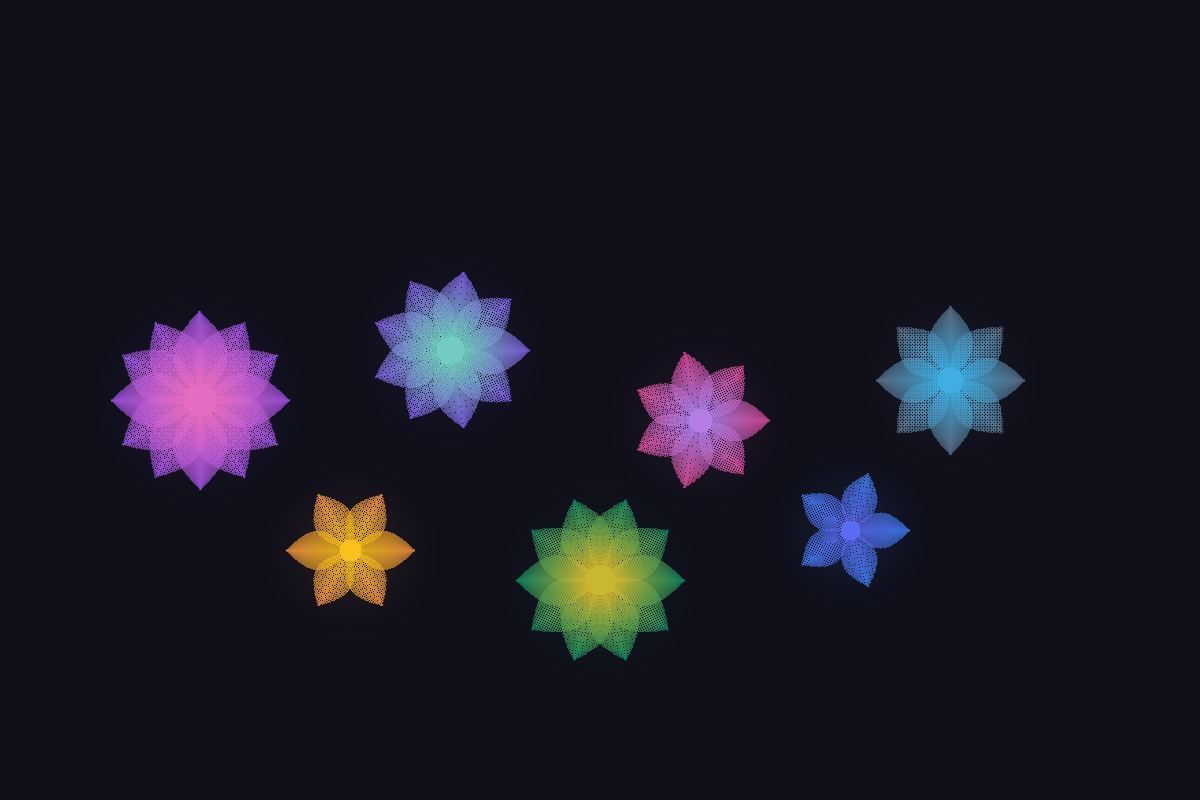
Flowers is an interactive data visualization that transforms the subjective experience of psychoactive substances into animated botanical forms. Each flower represents a drug’s full experience timeline — from onset through come-up, peak, offset, and after-effects — compressed into a real-time animation.
How It Works
Every visual property of a flower maps to a pharmacological characteristic:
- Petals encode cognitive complexity — more petals mean a richer, more layered headspace with distinct thought patterns and altered perceptions
- Shape represents drug class — rounded for depressants/entactogens, pointed for stimulants, wavy for psychedelics, wispy for dissociatives, trumpet for deliriants, serrated leaf for cannabinoids
- Color follows drug class — warm reds/yellows for stimulants, cool blues for depressants, purples/greens for psychedelics, grays for dissociatives
- Size reflects intensity
- Sway indicates body load — heavier sway means more physical effects
- Center visualizes ego dissolution — during peak, the center expands outward and its boundaries dissolve into soft rings as the sense of self dissolves
- Stem represents total duration
- Glow marks the peak phase
- Background shows hallucination intensity with class-specific visual effects
Features
- Solo view: Click any flower to watch its full timeline with phase indicators, hallucination backgrounds, and generative audio
- Compare mode: Place two flowers side-by-side to see how their timelines and effects differ, with documented pharmacological interaction data and a hybrid flower showing the predicted combined experience
- Dose scaling: Adjust dose from low to high and watch the flower respond in real-time
- Generative audio: Each drug class has unique timbres — resonant harmonics for psychedelics, hollow metallic for dissociatives, percussive for stimulants, warm bass for depressants
- 100+ substances sourced from PsychonautWiki’s evidence-based data
Try it: artificialnouveau.github.io/flowers
Data sourced from PsychonautWiki. This project is for educational and harm reduction purposes only.